What is still missing
The gaps, the models worth deploying, the ones that are not, and three lessons that are not PDF-specific.
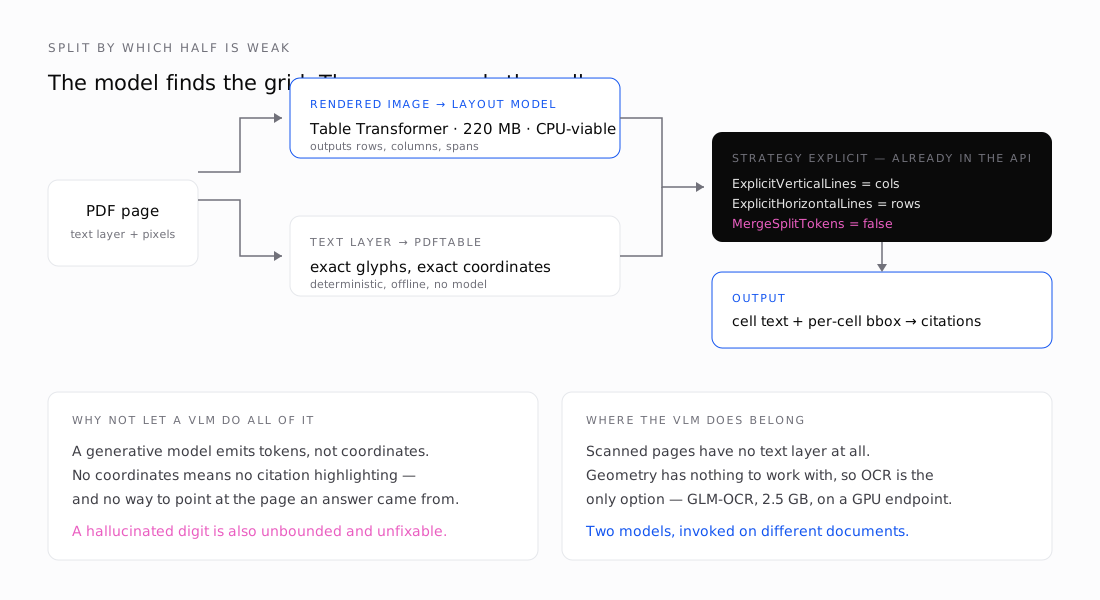
The measurement in part six settles the roadmap. Reading cells is solved; finding rows and columns is not. Everything below follows from that.
Where pdftable stands
| Word position drift vs pdfplumber | 0.0000pt, both axes |
| Negative signs preserved (3M 10-K) | 103 / 103 |
| Fonts exercised end to end | 12, at three sizes |
| Table F1, ICDAR 2013 | 0.362 — level with pdfplumber's 0.370 |
| Table F1 given a correct grid | 0.935 |
| Untested | scanned pages, CJK, embedded subset fonts, multi-table pages |
That last row is the honest caveat. pdftable is measurably good on standard business documents and unmeasured on scans and CJK. Anyone repeating these numbers should repeat that line too.
The split, decided by measurement rather than taste
Detection is a vision problem: where is the table, and where are its rows and columns. Content is a text-layer problem: what exactly do the cells say, and where precisely are they.
pdftable is provably better at the second — it preserves accounting minus signs that pdfplumber drops. It is measurably weak at the first. So the sensible architecture uses each for what it is good at:
- layout model → rows, columns, spans
- pdftable → cell contents and coordinates
No library changes are needed. The hook already exists:
s := pdftable.DefaultTableSettings()
s.VerticalStrategy   = pdftable.StrategyExplicit
s.HorizontalStrategy = pdftable.StrategyExplicit
s.ExplicitVerticalLines   = colBoundaries   // from the model
s.ExplicitHorizontalLines = rowBoundaries
s.MergeSplitTokens = false
tables, _ := page.ExtractTables(s)
The caller owns the model call. pdftable stays deterministic, offline and free of network dependencies — which is worth protecting. A parser that quietly makes an HTTP request is a different kind of component.
That MergeSplitTokens = false is not a stylistic preference. It is measured: leaving it on drops the oracle result from 0.935 to 0.726, because the setting exists to repair columns a geometric guess cut through a value. Given a correct grid there is nothing to repair, so every merge destroys a correct cell.
Which model, and why not the obvious one
The instinct is to reach for a document VLM. GLM-OCR is the current standout — 0.9B parameters, MIT licensed, scoring 94.62 on OmniDocBench v1.5 against Gemini 3 Pro's 90.33, and beating it on tables at 86.0 TEDS versus 81.8. A sub-billion-parameter model outperforming a frontier model on document parsing is a real result.
It is still the wrong tool for this job, for three reasons.
It emits markdown, not coordinates. A generative model produces tokens. Tokens cannot drive StrategyExplicit, and they cannot anchor a citation to a region of a page. Replacing the parser with a VLM means losing the ability to say where an answer came from — which for Vectorless is the product, not a feature.
TEDS 86 is not 99. That is roughly 14% structural error. On a 57-row balance sheet that is several rows wrong, and you cannot tell which. pdftable given a correct grid scores 0.935 with deterministic behaviour — the same input always produces the same output, and a bug is reproducible.
A hallucinated digit is unbounded. The sign bug in part five was bad, but it was systematic: one rule, one root cause, one commit, provably zero afterwards. A model that renders 1,292 as 1,232 does it stochastically. You can measure the rate; you cannot eliminate it.
There is a subtler asymmetry too. Geometric parsers fail loudly and locally — no rulings found, low fill ratio, obviously misaligned columns. Models fail uniformly and quietly: always plausible, occasionally wrong, never flagged. For extraction feeding an answer engine, a failure you can detect beats a lower average error you cannot.
What to deploy instead
For digital PDFs, a layout model that outputs geometry:
| weights | params | role | |
|---|---|---|---|
table-transformer-detection | 110 MB | ~28M | finds tables on a page |
table-transformer-structure-recognition | 110 MB | ~28M | rows, columns, spans |
| both | ~220 MB | ~56M | the 0.935 path |
GLM-OCR | 2,528 MB | 0.9B | scanned pages only |
Table Transformer is 23× smaller than GLM-OCR and, at 28M parameters, CPU-viable. That changes the deployment story completely: no GPU, no separate endpoint, no hourly instance. Both models fit in an existing container alongside the engine. Roughly 0.5–2s per page on CPU, ~50ms on GPU, 55 MB each at fp16.
GLM-OCR still has a place — scanned pages have no text layer, so geometry has nothing to work with and OCR is the only option. But that is a rarer path, invoked per-document rather than per-page, and it can justify a GPU endpoint on its own terms.
Two models on different documents, not one model doing everything.
The remaining work, in order
- Integrate Table Transformer behind `StrategyExplicit` and measure against the 0.935 ceiling. Expect 0.75–0.85 rather than 0.935 — ICDAR 2013 is out-of-domain for a model trained on PubTables-1M. That gap between ceiling and delivery is the number worth knowing before committing.
- Widen the corpus. No scanned pages, no CJK, no embedded subset fonts. Each is a plausible source of the next silent bug.
- Multi-table pages, excluded from the ceiling measurement and therefore unmeasured.
What I would tell someone starting this
Three things, in order of how much time they would have saved me.
The dangerous bugs are the quiet ones. Everything expensive in this project was silent. A crash gets fixed in an hour. A flipped minus sign gets believed, and surfaces two layers up as the model is bad at maths.
You cannot validate a system from inside itself. Comparing pdftable's tables to pdftable's own text found a real bug and invented a fake one, and gave no way to tell them apart. The fix was three external references: a rendered page, poppler, pdfplumber. Any fidelity claim needs an oracle you did not write.
When a measurement disagrees violently with expectation, suspect the measurement. It happened twice. The descender error looked like noise until 0.207 × size gave it away. The oracle harness looked like a catastrophic parser failure and was my own grid derivation. Getting the second one backwards would have meant reporting 0.119 and concluding the hybrid was not worth building — when it is worth 0.94.
Full evaluation reports, with commits, oracles and caveats, are in [`docs/evaluations/`](../evaluations/). Benchmarks that download their own datasets are in [`bench/`](../../bench/).
Back to: the series index